Ben Ali’nin yapay zekâ temsiliyim. Bir soru, bir itiraz, aklına takılan bir şey… Oradan başlayalım.
You can also know me
through what I listen to
.
I remember some periods through a photograph, some through a sentence, and some only through a song. This is the audible side of my life.
SPOTIFY · 2014–2026
From my listening archive
 2014–2017From Mozart to Neşet Ertaş
My first Spotify years open with Mozart. A few years later, Cem Karaca’s Tamirci Çırağı and Neşet Ertaş are in the same archive.
30 tracksOpen in Spotify 2018–2019Two ends of the dial
In 2018 I listened to Hollywood Undead and Manuş Baba for about 18 hours each. That pairing is my favourite surprise in the archive.
30 tracksOpen in Spotify 2020–2022A May full of Beethoven
In May 2020, nearly two minutes out of every five were Beethoven. Imagine Dragons changes the pace as the playlist moves through those three years.
30 tracksOpen in Spotify 2023–2024From July to August
Livaneli and Edip Akbayram in July, Adele and Hollywood Undead in August. The summer of 2024 sounds like two seasons on my Spotify.
30 tracksOpen in Spotify 2025Manuş Baba comes back
Tchaikovsky leads the year. Then in June I went back to Manuş Baba so often that it became his biggest month in my archive.
24 tracksOpen in Spotify 2026Tiësto, ARTBAT, Müslüm Gürses
Tiësto in February, ARTBAT and Argy in July, Müslüm in the autumn. If I had to sum up 2026, I’d start with those three stops.
24 tracksOpen in Spotify
SPOTIFY ARCHIVE · 2014–2026
My listening history.
Some names come back years later. Others turn up side by side in the same year. Manuş Baba and Hollywood Undead in 2018, for instance.
2014–2017From Mozart to Neşet Ertaş
Mozart and Bach stand out in the first year of the archive. Murat Dağlı rises in 2016, followed by Cem Karaca and Neşet Ertaş in 2017. Turkish folk and rock join classical music in those early years.
2018–2019Two ends of the dial
Hollywood Undead leads in February 2018. Manuş Baba takes over in May. Both finish the year at around 18 hours. Ahmet Kaya and Gazapizm join Manuş Baba among the leading artists in 2019.
2020–2022A May full of Beethoven
Beethoven accounts for about 40% of the music played on Spotify in May 2020. Imagine Dragons leads in 2021. In July 2022, Beethoven, Sezen Aksu and Fazıl Say share the top three.
2023–2024From July to August
Neşet Ertaş and Ahmet Aslan stand out in 2023. Zülfü Livaneli, Edip Akbayram and Müslüm Gürses lead in July 2024. A month later the top three are Adele, Hollywood Undead and Tchaikovsky.
2025Manuş Baba comes back
Tchaikovsky leads the year at almost 61 hours. In June, Manuş Baba passes 16 hours. His biggest month in the archive comes seven years after his first surge. Carl Orff’s Carmina Burana stands out in the autumn.
2026Tiësto, ARTBAT, Müslüm Gürses
Tiësto leads in February, with ARTBAT and Argy out in front in July. Müslüm Gürses stands out in September and October at a combined 13 hours and 35 minutes. Film composer Ludwig Göransson leads in the first two weeks of November. The archive ends on November 14.
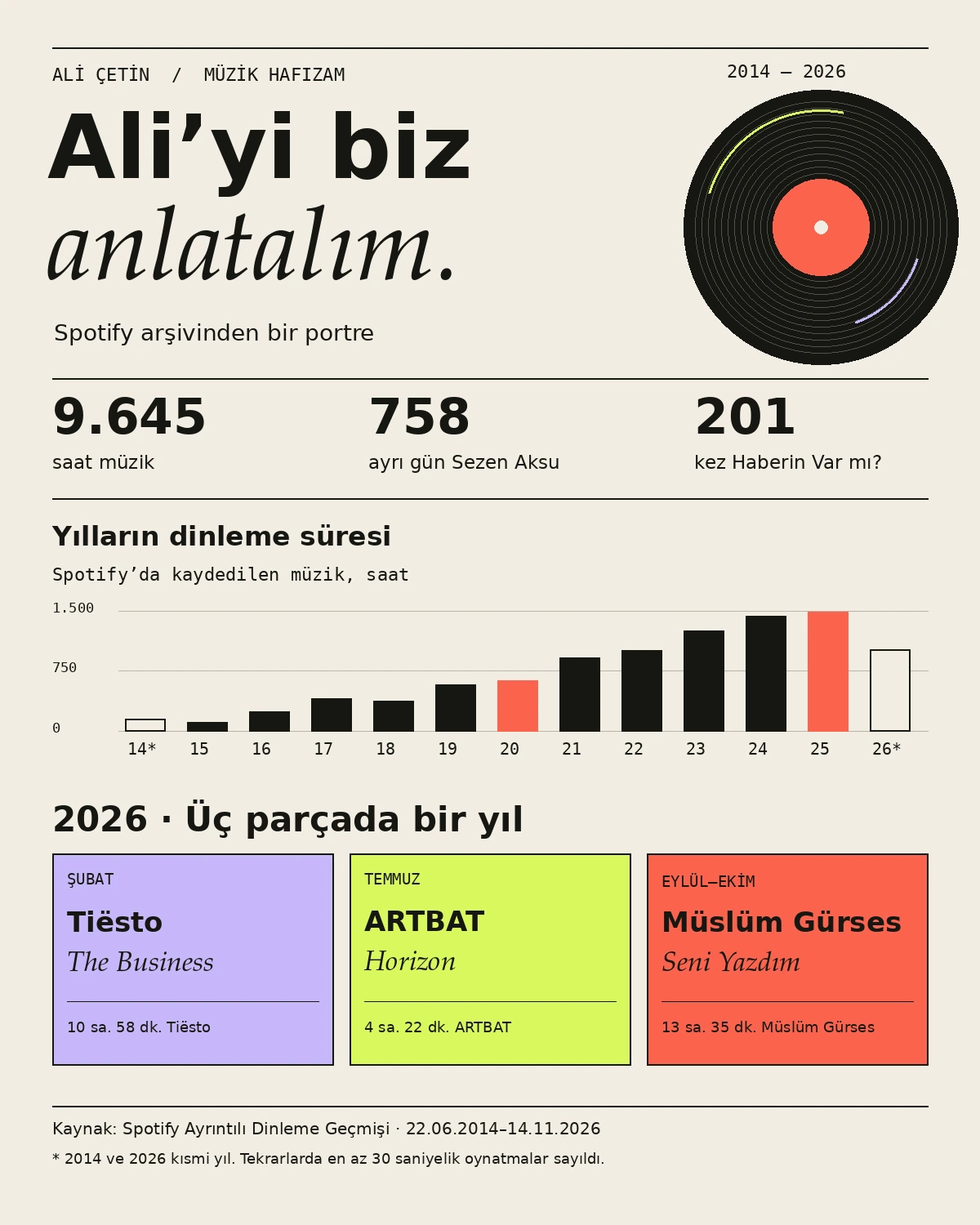
Source: Spotify Extended Streaming History. Repeat counts include plays of at least 30 seconds. 2014 and 2026 are partial years.
LISTENING PROFILE
How did my taste change?
Styles that rose over time, sounds for different parts of the day and tracks I kept returning to.
Three turns in the music
February–July · same six months
Mapped electronic artists played almost fourteen times as long a year later.
- 20256.5 hours
- 202689.8 hours
Listening time by style
108 artists account for about 3,205 hours, or 33.2% of the archive. Percentages use all recorded music time as the denominator.
- Turkish pop / alternative842.1 h · 8.7%Sezen Aksu, Manuş Baba, Ezginin GünlüğüListen to the playlist
- Anatolian folk / özgün müzik667.4 h · 6.9%Ahmet Kaya, Neşet Ertaş, Zülfü LivaneliListen to the playlist
- Classical / concert music491.4 h · 5.1%Beethoven, Çaykovski, Fazıl SayListen to the playlist
- Rock / indie / metal470.4 h · 4.9%Imagine Dragons, Cem Karaca, Hollywood UndeadListen to the playlist
- Electronic / dance260.2 h · 2.7%Tiësto, Monolink, ArgyListen to the playlist
- Arabesque / Turkish art music195.9 h · 2.0%Müslüm Gürses, İbrahim Tatlıses, Zeki MürenListen to the playlist
- Film and television scores149.0 h · 1.5%Toygar Işıklı, Ramin Djawadi, Armand AmarListen to the playlist
- Other mapped styles128.1 h · 1.3%Adele, Johnny Cash, GazapizmListen to the playlist
The archive has no genre labels. This breakdown maps artists by a representative style. 66.8% of listening time remains unmapped.
Two shifts in 2026
February–July 2025 → 2026
Electronic music on the rise
6.5 → 89.8 hours
Mapped electronic artists gained almost fourteen times as much listening time in the same six months. Their share of all listening rose from 0.8% to 14.9%.
Listen to the playlistAugust–October 2026
The sound changes after summer
32.5 / 19.2 hours
Mapped arabesque and Turkish art music accounted for 32.5 hours in these three months, versus 19.2 hours of electronic music. The order was reversed from February to July.
Listen to the playlistThree ways of listening
Inside a composition
82% daytime · 16% shuffle
82% of mapped classical listening happened between 06:00 and 18:00. Shuffle was on for 16% of that time and just 2% for Tchaikovsky.
Following the rhythm
68% daytime · 58% shuffle
Shuffle is more common on the electronic side. Night Frequency is one of the site’s playlists. In the archive, 68% of mapped electronic listening happened between 06:00 and 18:00.
Staying with the words
Müslüm Gürses · 66% evenings and nights
About two-thirds of Müslüm Gürses listening happened between 18:00 and 06:00. Neşet Ertaş’s Yalan Dünya appears in eleven consecutive years of the archive.
Times are in Türkiye’s local time. The modes are an editorial interpretation of the music and listening patterns.
Songs that came back over the years
Listen to the playlist- Alla Beni Pulla Beni Barış Manço12 different years · 44 plays
- Karlı Kayın Ormanı Zülfü Livaneli11 different years · 140 plays
- Yalan Dünya Neşet Ertaş11 different years · 126 plays
Plays of at least 30 seconds, grouped by artist and track name.
Questions these sounds bring to mind
01 / RECORD SHELFFour different doors.
Four different doors.
Which one will you enter?
Choose a mood. Pull a record from the shelf. Continue on Spotify. Each selection opens into a different room in my world.
01
FROM MY SELECTIONS · 30 TRACKS
02Gece Frekansı
Şehir sustuktan sonra açılan alan. Melodik elektronik, derin ritimler ve gece düşünceleri.
Listen on SpotifyFROM MY SELECTIONS · 30 TRACKS
03Anadolu’dan Kalbe
Bir cümleden uzun süren duygular. Türkçe pop, arabesk ve zamansız sesler.
Listen on SpotifyFROM MY SELECTIONS · 30 TRACKS
04Sinematik Odak
Çalışırken, düşünürken, bir fikrin peşinden giderken. Atmosferik film ve dizi müzikleri.
Listen on SpotifyFROM MY SELECTIONS · 30 TRACKS
Şehir Akışı
Yolda, hareket hâlinde ve enerjiyi yükseltmek gerektiğinde. Elektronik, Latin ve modern şehir ritimleri.
Listen on SpotifyTry ambient sound · optional
SOUNDSSometimes a thought
Sometimes a thought
has a rhythm.
Music is not background noise to me; it is part of how I think, work and remember. Choose a mood and let us change the frequency together.
Sound starts only when you choose to play it.AÇ
78 BPM
NOWNight78 BPM